When I began planning out this blog post, I had intended to use a learning design tool to map out a lesson or unit of lessons that I could or already have used in my classroom. One tool that appealed to me was the Learning Design Visual Sequence developed by the Australian Universities Teaching Committee (2003). This visual sequence attempts to represent teaching and learning activities visually (Dalziel, Conole, Wills, Walker, Bennett, Dobozy, Cameron, Badilescu-Buga, & Bower, 2016). I read through the descriptions provided on their website and had a go at structuring one of my kindergarten biological sciences lessons using the tool.
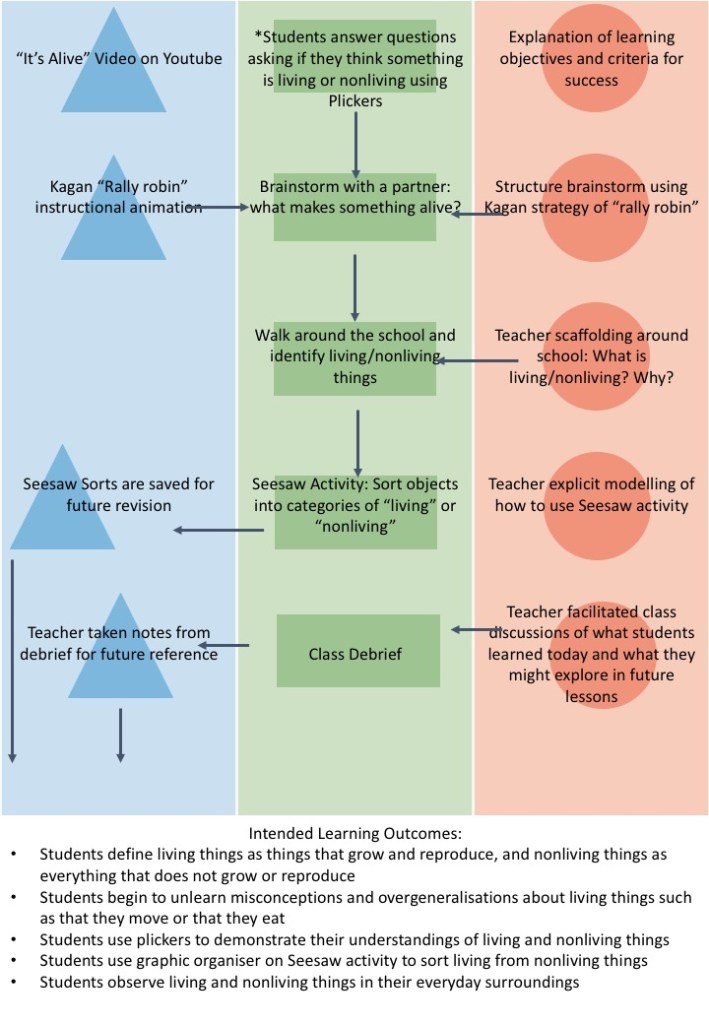
In the headings below, I will explore what I learned in using this tool.
Value-Added
I did not necessarily feel like I added any value to my lesson by using this tool. Although it was nice to see the elements of my lesson visually mapped out, I don’t think it necessarily improved my lesson design or made me think about it any differently. However, I do think it may be useful for pre-service teachers to further their understanding of the elements of lesson design.
Structure
As stated earlier, while it is visually appealing, the structure can be somewhat confusing to understand at first glance. In particular, the arrows and their direction or length and remembering what that means could take some getting used to.
Context
The rationale of the Learning Design Sequence is based on the work of Oliver (1999) that identifies the critical elements required in a learning design.

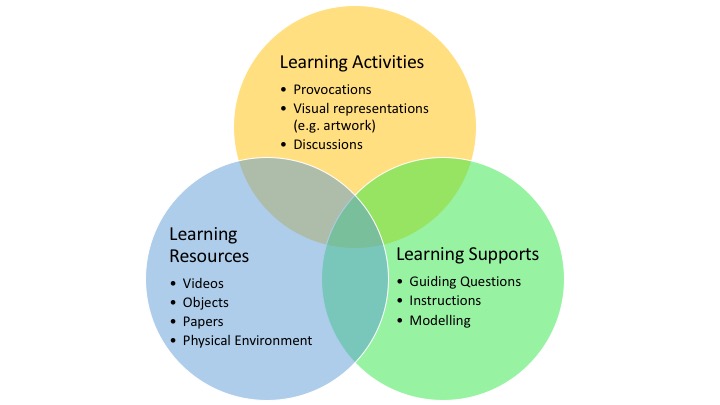
These elements were developed for the purposes of online learning – arguably a style of learning that will likely never be applied to the early childhood years, and possibly minimal application in middle to upper primary years. However, this diagram may still be useful in planning out units of work in primary classrooms if the contents are somewhat altered. I have included some ideas below. This isn’t fully developed, but is the product of a short brainstorm.
The actual learning design sequence is able to be applied to an early childhood setting as demonstrated by my example at the beginning of this post, however, it is usually implemented in tertiary institutions (Agostinho, 2011).
Final Word
Would I go through this process again? No. It was somewhat time-consuming and didn’t necessarily add value to my teaching. However, this tool may be more applicable to those teaching older age groups.
REFERENCES
Australian Universities Teaching Committee. (2003). The Learning Design Construct. Retrieved from http://www.learningdesigns.uow.edu.au/project/learn_design.htm#sequences.
Agostinho, S. (2011). The Use of a Visual Learning Design Representation to Support the Design Process of Teaching in Higher Education. Australasian Journal of Educational Technology, 27(6), 961-978.
Dalziel, J., Conole, G., Wills, S., Walker, S., Bennett, S., Dobozy, E., Cameron, L., Badilescu-Buga, E., & Bower, M. (2016). The Larnaca Declaration on Learning Design. Journal of Interactive Media in Education, 2016(1), 1-24.
Oliver, R. (1999). Exploring strategies for online teaching and learning. Distance Education, 20(2), 240-254.
 Kayla Chester EDCN865