
What is Seesaw?
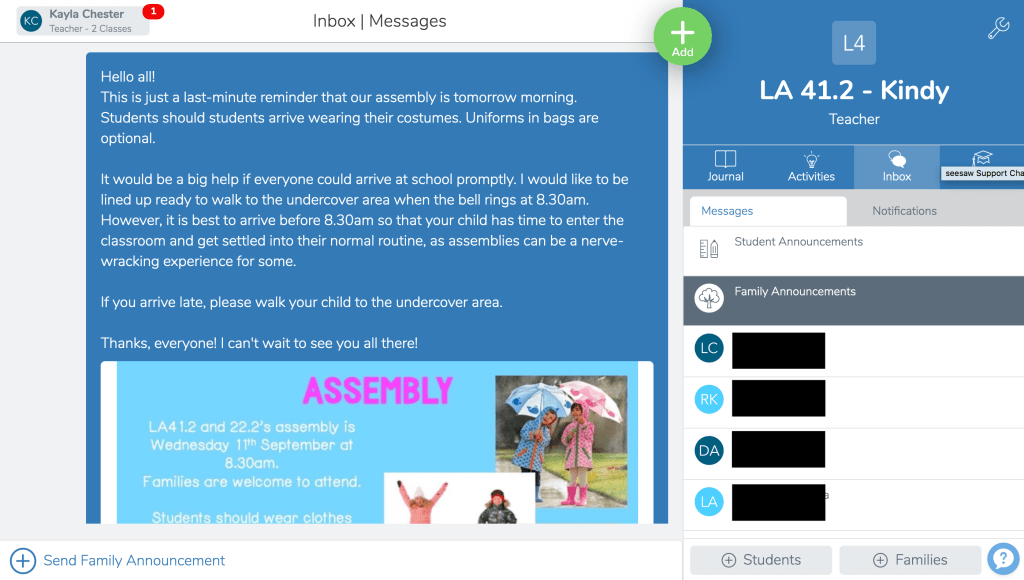
Seesaw is a online learning portfolio that families of students can access. Users can use Seesaw to upload a range of file types including images, videos, audio, and text. Teachers can also use Seesaw to set activities and collect assessment data on uploaded items, post class announcements, and message family members privately.
Is it a social networking tool?
Boyd & Ellison (as cited in Bower, 2017) lists three characteristics of social networking sites:
- Users can construct a public or semi-public profile
- Users can articulate a list of other users with whom they share a connection, and
- Users can view these connections and the connections of others in the system
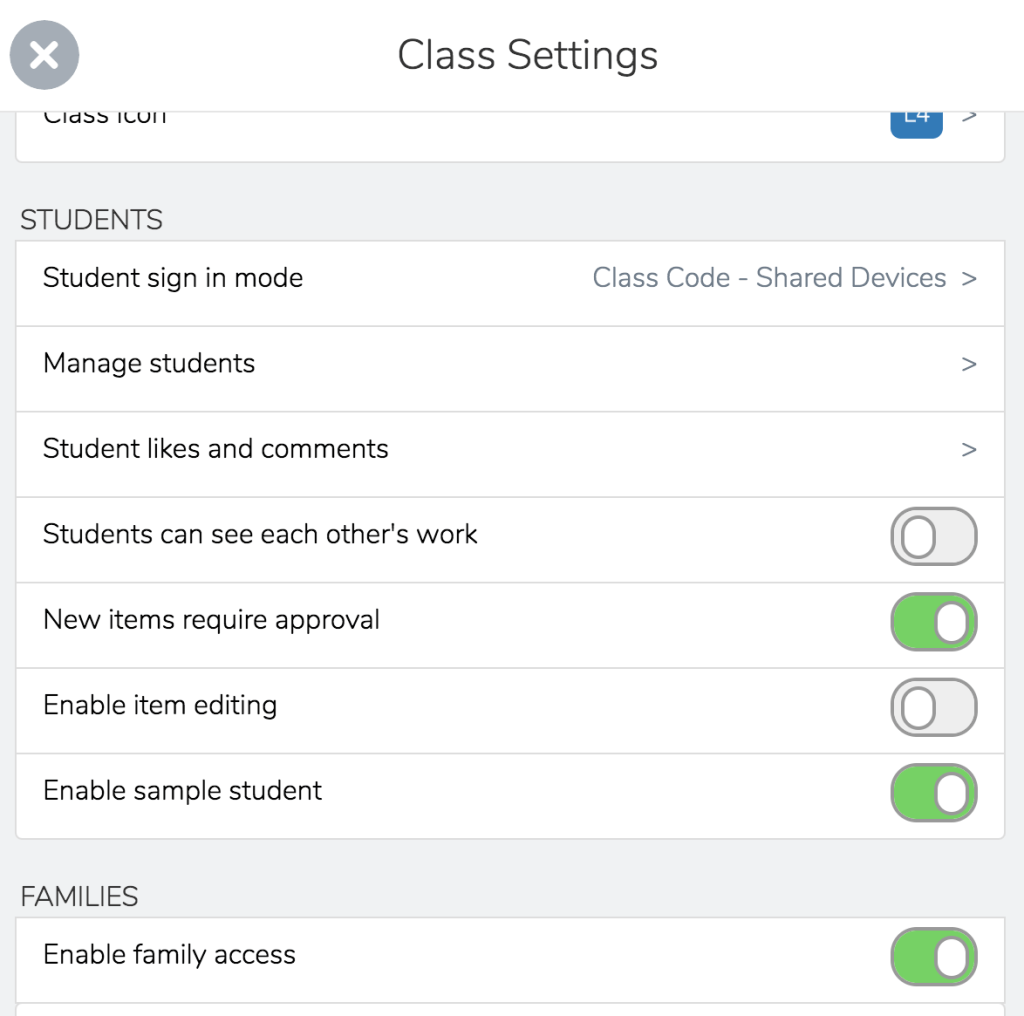
Seesaw is designed for classroom use, and therefore student profiles are kept private and only visible to their teacher(s), family members who have connected to their Seesaw, and their peers (although this option can be turned off).
What are some of the benefits of Seesaw?
Home Communication
Families connected to their child’s Seesaw journal get a glimpse into their child’s day and in the case of assessment tasks, an understanding of how their child is progressing. It has also been used by speech pathologists to communicate to parents what skills children were working on and activities families can do to support them (Ray, 2017).
Developmentally appropriate for the early years
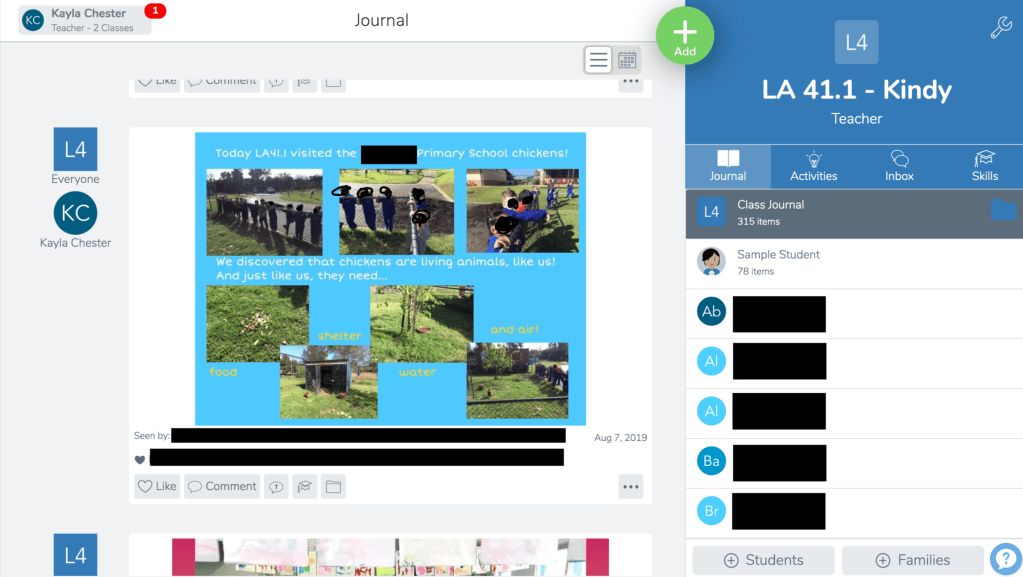
It can sometimes be a challenge for early childhood teachers to find technologies that are appropriate for younger children and that complement play-based learning approaches. Fantozzi, Johnson, & Scherfen (2018) found that Seesaw worked well with play-based pedagogies because teachers were able to caption photos to give families “a much more well-rounded look inside the classroom than the tangible products (like paintings) that were sent home” (pp. 91-92).
Below is a more comprehensive list of the benefits of seesaw:
What are some things to consider when using Seesaw?
Data and privacy
Some parents and educators have concerns about the privacy of Seesaw given that the data is stored in California and that educators are sharing images of minors on the platform. You can read the Privacy Evaluation on Seesaw published by Common Sense here.
Issues relating to parental access
Educators using Seesaw need to do so with consideration for their students’ family situations in mind. Comments on a child’s work sample by a family member can be viewed by other family members connected to the child’s journal, which may be an issue in some circumstances.
How do I use Seesaw?
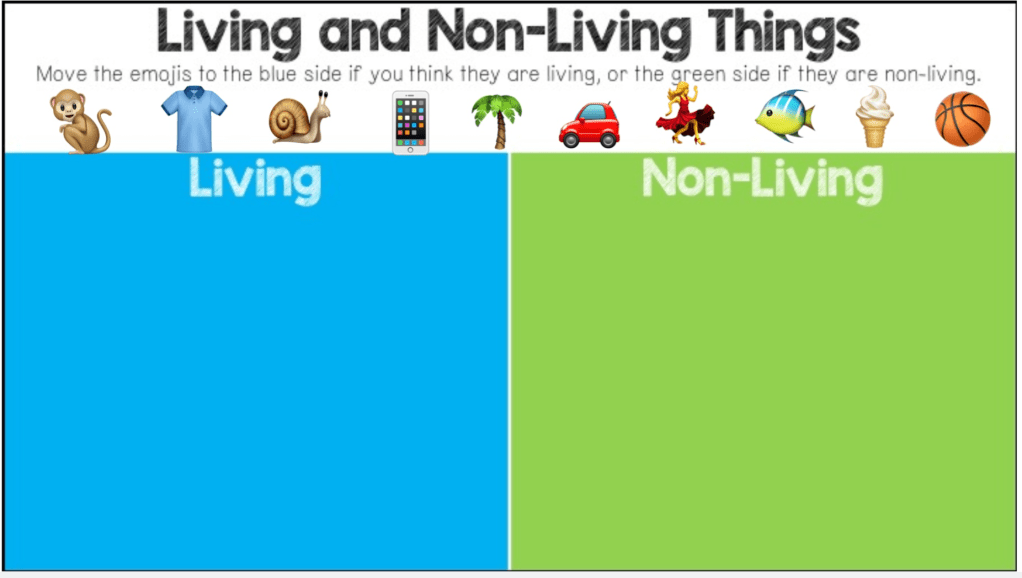
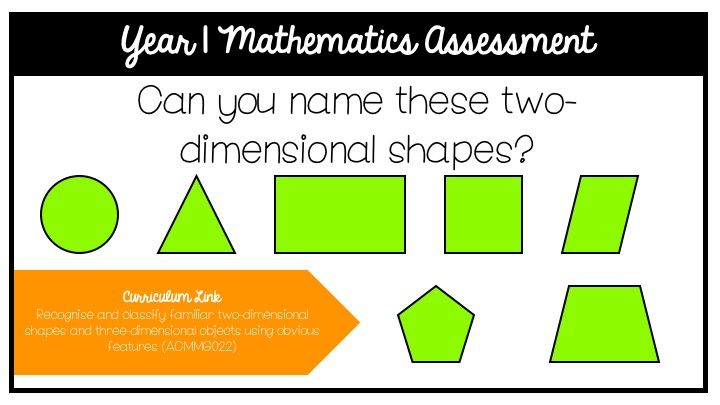
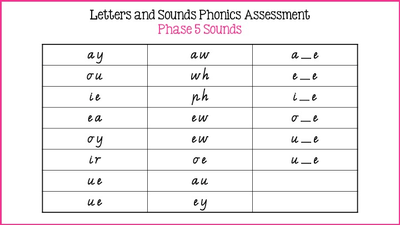
As an early childhood educator, I use the audio and visual tools extensively over text tools. I also often use the ‘Activity’ function to set assessments for my students.

References
Bower, M. (2017). Design of technology-enhanced learning – Integrating research and practice. Bingley, UK: Emerald Publishing Group.
@Sylviaduckworth (2016, December 15). Sketchnote of “Top 10 Reasons to use Seesaw”. Retrieved from https://twitter.com/sylviaduckworth/status/809598470029971456?lang=en.
Fantozzi, V., Johnson, C., & Scherfen, A. (2018). Play and Technology: An Important Intersection for Developing Literacy. Young Children, 73(2), 88-93.
Ray, A. (2017). ‘Seesaw’ Between School and Home. ASHA Leader, 22(5), 1-2.
Seesaw Learning, Inc. (n.d.). Seesaw logo [image]. Retrieved from https://help.seesaw.me/hc/en-us/articles/203816959-Seesaw-icon-and-logo.

 Kayla Chester EDCN865
Hi Kayla,
Thank you for your post on the platform SeeSaw.
I find it fascinating that students coming through the younger years will see social media as an integral and normal part of their learning which is quite opposite to how I see students use social media in high school.
While students might use applications like Facebook to communicate with each other and share snapshots of their learning in class, none of this is sanctioned by the school as we have a strict social media policy for the protection of the students in our care.
What is fantastic is that a platform like SeeSaw is that it could be a positive way for social media to be integrated into a students learning while separating their personal social media from class.
Like Class Dojo (“Learn all about ClassDojo ♥”, 2019) there is an aspect to the platform where by parents can be given updates about the learning happening in the class in a day however I think that SeeSaw has a greater inter-student engagement which from what I understand is not as strong in Class Dojo.
While students could, of course, use access to the profiles of other students for negative behaviours, I am encouraged that there would be greater transparency of student work so that students can learn from the learning of their peers and give positive feedback on their learning.
As an early childhood educator, do you think social media platforms like this will become a staple in the classroom due to most people now having a social media profile for their lives? What would/does that look like for you in the age group that you teach?
References:
Learn all about ClassDojo ♥. (2019). Retrieved 10 October 2019, from https://www.classdojo.com/
LikeLike
Kayla,
A really thoughtful and thorough post. It certainly fits Boyd & Ellison’s (in Bower, 2017) criteria for what constitutes social media. To me, what is even more interesting is that the social media aspect is one that relates to the parents. This type of technology gives parents a much more in-depth look at what their children are doing in the educational environment. Knauf (2016) also notes that by connecting family members around their child’s activities at school, it connects family members in a meaningful way that would not be possible in a different context.
The platform my school uses, Schoology, is targeted for slightly older students (I believe our district uses it only at the middle and high-school level, not for elementary students) – and by contrast, seems concerned with respecting student privacy over what one might consider a parent’s “right” to know certain information. While parents have their own log-in through which they can see upcoming homework assignments, they cannot access information regarding their child’s grade or any assignments they may not have submitted. Very occasionally, a parent writes to a teacher complaining their child refuses to let him/her see their grades and asks for help in this regard.
As these technologies become more prevalent, I am curious as to whether parents will attempt to assert their influence based on what they see on the platform. Parent communication even by email is often a delicate balance, and I have had my share of parents off to “help” guide my curriculum when they are not happy about a particular book selection. I do wonder how long before parents begin to request that teachers live-stream their classes, so they can check in on how their child is interacting with others.
References.
Bower, M. (2017). Design of technology-enhanced learning: integrating research and practice. Emerald Publishing Limited.
Knauf, H. (2016). Interlaced social worlds: exploring the use of social media in the kindergarten. Early Years, 36(3), 254-270
Schoology. “Learning Management System: LMS.” Schoology, http://www.schoology.com/.
LikeLike